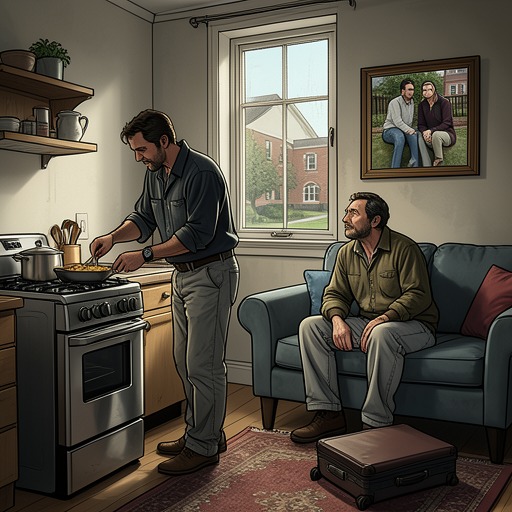
University dormitory
𝐋𝐚𝐜𝐮𝐧𝐚 | 𝑱𝒆𝒐𝒏 𝑱𝒖𝒏𝒈𝒌𝒐𝒐𝒌The university student dormitory is more than student housing in the novel. At Central Washington University in Ellensburg, it becomes the first sustained setting in which Shelby Anderson Barnum and Jungkook Jeon live near one another, encounter each other outside public performance, and reveal conditions that neither can safely display elsewhere. Its rooms hold solitude, self-harm, nightmares, intoxication, artistic fantasy, friendship, and hesitant care, making the dormitory the story’s most important early threshold between private suffering and human connection.
Arrival and Private Territory
On Monday, September 1, Shelby arrives at Central Washington University and enters the student dormitory with Dorcas Peters, whom she has just met. Her assigned room is still undecorated and carries the stale smell of a space left closed. Shelby opens the window, unpacks belongings that had been delivered a month earlier, and begins arranging the room according to her own image. She has specifically requested to occupy it alone rather than share it with a roommate. That decision establishes the room as a controlled retreat: she can determine who enters, what remains hidden, and how much of herself becomes visible.
The room nevertheless resists complete isolation. After Shelby has begun making it personal, Dorcas appears at the door and asks her to show her around campus. The doorway immediately changes the dormitory from a sealed refuge into a point of contact. Shelby’s private territory remains hers, but friendship begins through its threshold, and the room becomes a place where guarded independence can be approached without being entirely surrendered.
A Space of Exposure and Distress
The dormitory exposes the physical cost of Shelby’s inner pain. On September 2, she wakes at eight after having already been awake since five in the morning. After showering, she wipes the steam from the mirror and looks at herself, something she has avoided for years. Tears follow as she confronts a body she experiences as a reflection of anxiety, resentment, and profound unhappiness. The room and its adjoining private spaces therefore do not offer uncomplicated comfort; they also return her own image to her when she is unable to escape it.
Later, the dormitory becomes the site where Dorcas discovers Shelby harming herself. In a flashback, Dorcas recalls opening Shelby’s door and finding her self-mutilating, her expression empty. Namjoon Kim examines the severe burn covering the front of Shelby’s left forearm while Dorcas and Namjoon attempt to care for her. The room transforms the abstract knowledge of Shelby’s suffering into an immediate bodily crisis, and the closed door that once protected her privacy becomes the boundary through which her friends finally recognize the seriousness of her condition.
Shelby’s distress also appears through sleep. In the dormitory, she eventually lies beneath a quilt and falls asleep, but Jungkook later notices her moving restlessly, breathing in broken rhythms, and overwhelmed by panic. Her nightmares make the bed an unstable refuge: it shelters her body while simultaneously reopening the fears that prevent genuine rest. Jungkook’s decision to remain attentive to her suffering begins a shift in the room’s emotional function, from solitary concealment toward reluctant mutual observation.
Jungkook’s Room and the Shadow of Ares Garden
The dormitory is also the point to which Jungkook returns after performing a far more violent identity elsewhere. At Ares Garden, he bandages his fists and wrists, enters the ring to the acclaim of spectators throwing dollar bills, and fights until an opponent is unconscious. Ares Garden is known for illegal fights, and Jungkook is its emblematic fighter. He refuses to kill an opponent, but the possibility of a fight ending in death hangs over the spectacle. When the night ends, the dormitory offers the physical continuation of that violence: a room, a bed, bandages, and the silence in which the fighter’s demons follow him home.
Jungkook’s room also contains a less visible self. After Connor Barnum warns him to stay away from Shelby, Jungkook drives his black 1968 Ford Mustang GT back to campus and returns to his room. Lying on his bed, he imagines a sensual figure illuminated by moonlight, then takes his sketchbook and pencil to draw the image. Without consciously intending to, he gives the imagined woman Shelby’s face. The dormitory thus becomes the place where his public aggression and private fascination coexist: the room holds the artist who can imagine tenderness and the fighter who remains identified with darkness.
The same room is repeatedly breached by crisis. Jungkook arrives at Shelby’s door visibly intoxicated, and she helps him walk to his bed before sitting nearby, uncertainly handling the fabric of her shorts. The scene reverses their familiar positions. He is usually the dangerous, unreadable presence; here, he is physically impaired and dependent on her practical care. The dormitory makes that dependence possible because it is close enough to permit an unplanned arrival and private enough to contain the humiliation of being seen helpless.
Care, Friendship, and Unstable Intimacy
The dormitory’s rooms connect several networks of support. Sunmi Eun’s psychological care gives Shelby a professional context in which she can begin discussing her history, including her mother’s death from generalized cancer when Shelby was eight. When Shelby’s breathing becomes difficult, Sunmi holds her hands, guides her breathing, and recognizes the depth of the student’s psychological fragility. Shelby later explains that the aftermath of her trauma has included self-harm, an eating disorder, and cannabis use; she also says that she previously had a psychologist in Los Angeles and now sees a colleague of that clinician. The dormitory is not the treatment room, but it is where the consequences of trauma are lived between appointments.
Dorcas’s friendship offers a different form of care. She notices the disorder in Cassiopée Smith’s room and understands that Cassiopée has been using more than cigarettes, then restores the space while worrying about what will happen next. Her actions show how dormitory life makes private deterioration visible through ordinary material details: an unclean room, a closed door, a body lying on a bed, or a friend who cannot conceal fear. The residence creates an informal system of observation that is imperfect but emotionally decisive.
Namjoon and Dorcas also interpret the developing bond between Shelby and Jungkook from within this environment. Namjoon is not surprised that Jungkook has chosen to care for Shelby because he knows what his friend has confessed. He senses that a close connection has formed between two lost souls who are simultaneously searching for themselves and for each other. The dormitory gives that relationship its early shape through repeated proximity rather than a single declaration: one person arrives drunk, another suffers through sleep, one friend waits outside a door, and another sits beside a bed without knowing what can be repaired.
Jungkook’s own conduct reveals that the change is not limited to Shelby’s perception of him. Sitting beside her while she sleeps, he touches her cheek, studies her hands, and feels an unfamiliar anger at the danger she has placed herself in. The gesture contrasts sharply with his violence at Ares Garden. His concern does not erase his brutality or trauma, but the dormitory allows a quieter impulse to become observable: he can remain near a vulnerable person without turning the encounter into a fight.
Threshold, Memory, and Later Continuity
The dormitory is structured by thresholds. Doors separate solitude from friendship, rooms separate public identities from private damage, and corridors carry characters between overheard suffering and direct intervention. Shelby’s request to live alone initially makes the dormitory a place of withdrawal, yet the same arrangement becomes the setting in which Dorcas reaches her, Jungkook seeks her, and friends gather around crises that can no longer remain hidden. The building therefore produces both concealment and disclosure.
Its chronology is also layered. Ordinary present-time scenes are interrupted by a nightmare and by analeptic recollections, especially Dorcas’s memory of discovering Shelby’s self-harm. This movement between current rooms and remembered violence gives the dormitory an accumulated emotional geography: the same beds and doors hold what is happening now and what the characters are unable to leave behind. The residence feels temporary in institutional terms, but psychologically it becomes saturated with repetition.
Even after the couple’s life expands beyond Ellensburg, the dormitory remains part of the relationship’s origin story. Much later, Shelby and Jungkook share a home in Los Angeles, where he promises not to abandon her before she enters the courtroom in Robert Jefferson’s case. That later scene shows how far their bond has traveled from the dormitory’s tentative acts of care. The early residence did not solve either character’s suffering; it supplied the enclosed, recurring space in which care could first become a practice rather than an exception. Its decisive significance lies in that transformation: a place chosen for separation becomes the setting where isolation is repeatedly interrupted, and where two damaged people begin to be seen by others and by each other.